Kale Fortress
Kale Fortress
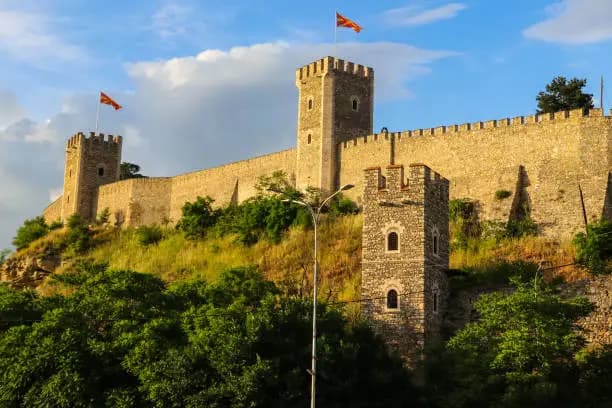
Perched above the Old Bazaar, Kale Fortress offers the finest panorama of Skopje and archaeological remains spanning four millennia of history.
Rising on a hilltop overlooking central Skopje, Kale Fortress is the oldest and most visible monument in the Macedonian capital. Its limestone ramparts loom above the Ottoman bazaar and the Vardar River. Inhabited since the Neolithic period, this strategic site has witnessed the passage of Byzantine, Bulgarian, Serbian and Ottoman empires before becoming the architectural symbol of the modern city.
Practical information at a glance
- Entry: free (open access to outer ramparts)
- Recommended duration: 45 minutes to 1.5 hours depending on exploration
- Access: on foot from the Old Bazaar (Čaršija) in 10-15 minutes via a paved path
- Dress code: comfortable walking shoes recommended — uneven terrain on the ramparts
- Accessibility for mobility-impaired visitors: limited, steep climb with no specific facilities
What to see
The partially restored medieval ramparts form an irregular enclosure with several towers. Inside, archaeological excavations have uncovered remains ranging from the Bronze Age to the Ottoman period. A large ceramic amphora, a symbol of the city, stands within the fortress walls. The panorama over Skopje — rooftops, minarets, the Stone Bridge and Vodno hill — is the main reward for the climb.
History and context
The site has been inhabited for at least 4,000 years. The Byzantines built a fortress here in the 4th–6th centuries. The 1963 earthquake damaged some of the remaining structures. Consolidation and development work has been undertaken several times since North Macédoine's independence in 1991. The name "Kale" comes from the Turkish kale, meaning simply "fortress".
Highlights of the visit
The panorama over Skopje
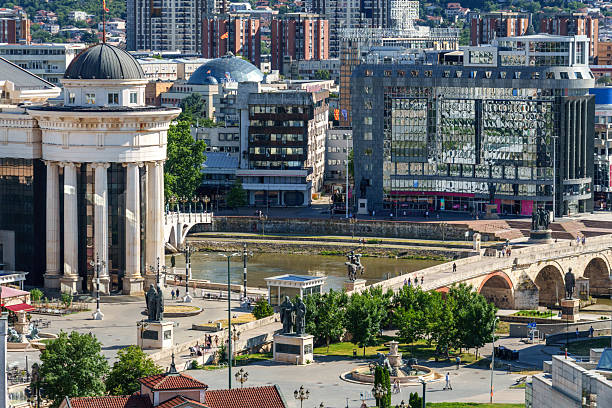
From the highest point of the ramparts, the view encompasses the entire city centre: the Stone Bridge, Macedonian Square, the minarets of Mustafa Pasha Mosque and, on clear days, Mount Vodno with its Millennium Cross.
The archaeological excavations
Part of the site is undergoing excavation. Successive layers of civilisations — Neolithic, Ancient, Byzantine, Ottoman — are visible here. Explanatory panels (in Macedonian and English) mark the route.
The medieval ramparts and towers
The best-preserved sections date mainly from the late Byzantine and medieval periods. Some towers allow you to walk along the battlements and observe the original masonry, blending reused Roman bricks with dressed stone.
Photography tips
Morning light (before 10 a.m.) is ideal for photographing the city without backlighting. In late afternoon, the setting sun illuminates the Old Bazaar roofs from the northern ramparts. Avoid midday: the white stone overexposes easily. No known photography restrictions on site.
Location and access
The fortress is located at the northern edge of the Old Bazaar (Čaršija), Skopje's historic Ottoman quarter. The main access path departs from the street bordering the Mustafa Pasha Mosque. From Macedonian Square, allow about 20 minutes on foot crossing the Stone Bridge. No dedicated parking; public transport stops (city centre) are within a few minutes' walk.
Nearby attractions
- Old Bazaar (Čaršija) — the largest Ottoman bazaar in the Balkans outside Turkey, at the foot of the hill.
- Mustafa Pasha Mosque — a 15th-century Ottoman building, two minutes' walk away.
- Stone Bridge — medieval bridge over the Vardar, a symbol of Skopje.
- Macedonian Museum of Archaeology — collections covering the same historical periods as the Kale site.
Frequently asked questions
Access to the outer ramparts is free. Some excavation areas may be temporarily closed to the public depending on the progress of archaeological work.
Spring (April–May) and autumn (September–October) offer pleasant temperatures for the climb. In summer, the heat can be intense on exposed ramparts; bring water and a hat.
Yes, this is the most natural combination. Start with the Bazaar in the morning, then head up to Kale in late morning to enjoy the light and avoid the lunch-time crowd.
No, the climb is steep and the terrain inside the ramparts is uneven. There are no specific facilities for people with reduced mobility.
No photography restrictions are indicated. The site is open and the ramparts are freely accessible for photographing the city and the remains.
Interested in this visit?
We can include it in your personalised itinerary.