Bay of Bones (Baie des os)
Bay of Bones (Baie des os)
On the southeastern shore of Lake Ohrid, the Bay of Bones reconstructs a prehistoric stilt village and preserves submerged remains from an Illyrian occupation.
The Bay of Bones, also known as the Water Museum, reconstructs a prehistoric stilt village on the southeastern shore of Lake Ohrid in North Macedonia. The site lies approximately 13 km from Ohrid's city center, along the main road toward Sveti Naum, and falls within the UNESCO World Heritage perimeter designated for Lake Ohrid.
Why Visit the Bay of Bones
The site brings together three rarely combined features on a single shore: an open-air archaeological museum built above the water, submerged remains still under study, and a restored Roman castellum on the heights. The reconstruction allows visitors to walk across the walkways of an actual stilt village as it may have existed between 1200 and 700 BCE, while original artifacts are displayed in an adjacent building.
For travelers exploring Lake Ohrid's shores, it also serves as a logical stop between the old town of Ohrid and the Sveti Naum monastery, midway to the Galitchitsa National Park.
History and Archaeological Discoveries
The original village was inhabited by the Encheleians, an Illyrian people settled around the lake. The inhabitants benefited from a resource-rich environment—fishing, fresh water, cultivable land—and the natural protection offered by the lake. The occupation spans the Bronze Age to the Iron Age, roughly 1200 to 700 BCE.
The first underwater archaeological explorations were conducted in 1977 at the Plocha Michov Grad site (also spelled Ploca Micov Kamen), along the Gradište peninsula. Systematic excavations resumed in 1997 and uncovered approximately 6,000 wooden pilings submerged 3 to 5 meters deep. The lake's anaerobic conditions ensured remarkable preservation of wood and organic materials.
Researchers estimate the village covered roughly 8,500 m², on a platform 10 meters from shore, measuring 155 meters east to west and 55 meters north to south. The original village is thought to have contained about 60 dwellings.
Among the artifacts discovered are:
- pottery and ceramic vessels;
- stone and flint tools;
- bronze and iron weapons;
- animal bones;
- jewelry and ritual objects.
No human remains have been found at the site, suggesting inhabitants practiced body cremation. The location's name derives from the numerous animal bones and ceramic fragments recovered during underwater excavations.
What to See on Site
The stilt village reconstruction project was completed in 2008. Twenty-four dwellings were rebuilt on the wooden platform resting on pilings, faithful to prehistoric construction techniques. A walkway connects the houses, and a movable wooden bridge joins the mainland—a feature that, according to archaeological theory, likely existed in prehistoric times as a security measure against intrusions.
The museum building, at the water's edge, presents a permanent exhibition of original artifacts and a large wall photograph showing the submerged remains as they appear underwater today. An underwater archaeology research station is also established on-site.
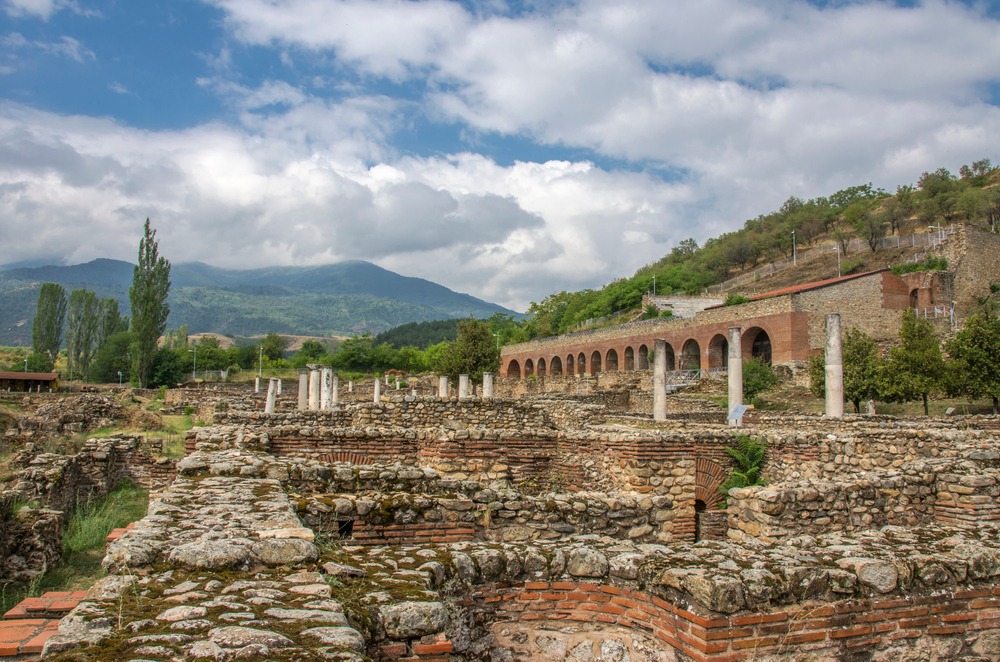
On the heights, a restored Roman castellum overlooks the bay and provides an interesting complement to the prehistoric village visit. Trails and viewpoints allow visitors to connect both sites on foot.
Practical Information
The site is open year-round, generally every day except Monday, with extended hours during peak summer season and more limited hours in winter. It's best to verify opening hours in advance with Ohrid's tourist office. Entry is charged at a modest rate including the reconstructed village and museum space.
On-site you'll find a visitor center, a café with terrace, picnic tables, restrooms, and rest areas. Allow 1 to 2 hours for a comfortable visit, longer if you ascend to the castellum or extend the experience with water activities.
Best Time to Visit
The most favorable period extends from May to September: mild to warm temperatures, lake conditions suitable for boat excursions, and organized diving by Amfora Dive Company accessible in good visibility conditions. July and August concentrate tourist traffic across the entire shore; for a quieter visit, favor late spring or early autumn. In low season, some boat services and diving are suspended.
How to Get There
By car
From Ohrid, follow the main road toward Sveti Naum / Trpejca. The site is signposted on the right, just before the village of Trpejca. Allow approximately 20 to 30 minutes of travel depending on traffic. Parking is available at the museum entrance.
By bus
Public buses connecting Ohrid to Sveti Naum serve the site, with a journey of 30 to 45 minutes from Ohrid's bus station. Frequencies vary and are more spaced out outside the season; inquire in advance and plan your return accordingly.
By taxi
Taxis remain affordable in North Macedonia. It's common to negotiate a round trip with waiting time, which becomes economical for groups.
By boat
In high season, several excursions departing from Ohrid's waterfront make stops at the Bay of Bones, either as part of cruises to Sveti Naum or circuits combining churches and riverside villages. The stop sometimes lasts only about thirty minutes on larger vessels; private small boats offer more flexible visiting time.
Nearby Attractions
The southeastern shore of the lake concentrates several complementary sites:
- the Galitchitsa National Park, whose trails offer panoramic views of Lakes Ohrid and Prespa;
- the Matka Canyon, further inland, for extending a Macedonian itinerary;
- the Saint Jovan Bigorski Monastery, a major monastic complex in the country's west;
- the Arabati Baba Teqe in Tetovo, a witness to Bektashi Sufism in the Balkans.
Frequently Asked Questions
Frequently asked questions
The site is situated on the southeastern shore of Lake Ohrid, approximately 13 km from Ohrid's city center, on the road leading to Sveti Naum in North Macedonia.
The name comes from the numerous animal bones and pottery fragments brought up during underwater excavations. No human remains have been identified, suggesting inhabitants practiced body cremation.
Yes, it is part of the World Heritage property designated for Lake Ohrid, which covers the entire natural and cultural heritage of the region.
Yes, guided dives are organized by Amfora Dive Company, primarily during the summer season. The submerged remains lie 3 to 5 meters deep, making them accessible to both beginner and experienced divers.
Allow 1 to 2 hours to explore the reconstructed village and exhibition. If you ascend to the Roman castellum or extend with a boat excursion, plan for a half-day.
Planning Your Trip
The Bay of Bones integrates naturally into a circuit around Lake Ohrid and more broadly into a discovery of North Macedonia, between ancient heritage, Orthodox monasteries, and the nature of the Balkans.
Interested in this visit?
We can include it in your personalised itinerary.