Heraclea Lyncestis
Heraclea Lyncestis
Founded by Philip II in the 4th century BC, Heraclea Lyncestis preserves some of the Balkans' finest Early Christian mosaics in Bitola, a Roman theatre, and a rich ensemble of ancient ruins.
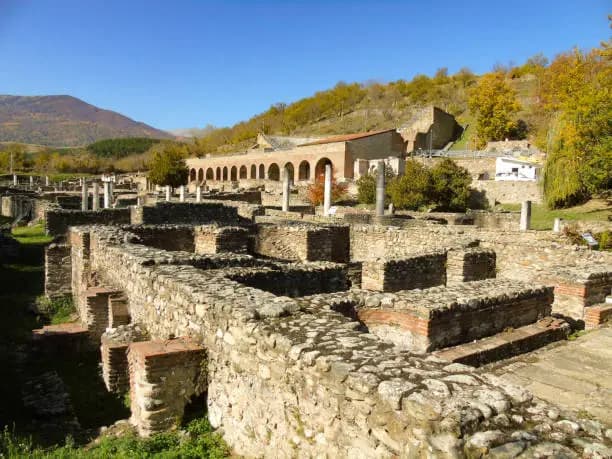
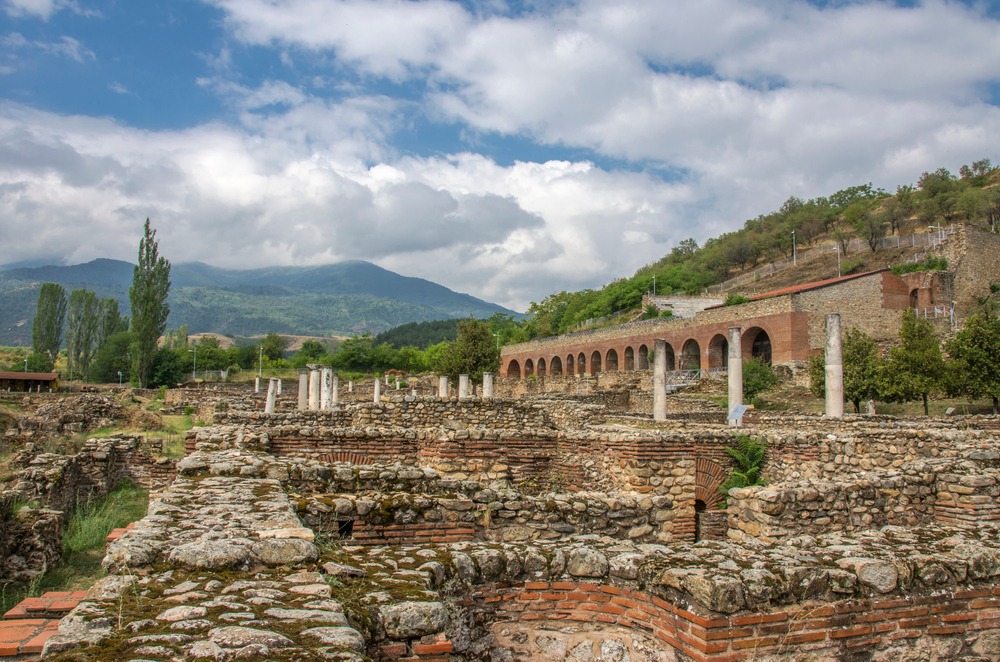
Heraclea Lyncestis is an ancient archaeological site located on the southern edge of Bitola, in southern Macedon. Founded in the 4th century BC by Philip II of Macedon, the city flourished through the Hellenistic, Roman, and Early Christian periods. Its floor mosaics, among the best preserved in the Balkans, and the remains of basilicas make it a major destination for those interested in Late Antiquity.
Quick Facts
- Admission: paid (modest fee)
- Suggested duration: 1 to 1.5 hours
- Access: on foot from Bitola centre (approximately 15–20 minutes) or by taxi
- Dress code: no restrictions; comfortable walking shoes recommended (uneven terrain)
- Accessibility: limited — pathways partially developed, but terrain remains rough
What to See
The site reveals several well-excavated complexes. Two large Early Christian basilicas (4th–5th century) dominate the space; their floors preserve polychrome figurative and geometric mosaics of remarkable finesse. A Roman theatre carved into the hillside, a colonnaded portico, and baths round out the ensemble. A small necropolis with funerary stelae is also visible.
History and Context
Philip II founded the city around 358 BC following his victory over the Lyncestians, a local people. It took the name Heraclea in honour of Heracles, the mythical ancestor of the Argeads. Under Rome, it became a stop on the Via Egnatia, the strategic route linking the Adriatic to Byzantium. In the 4th century, it served as an episcopal seat; the basilicas testify to this Christian prosperity before Slavic invasions in the 6th century brought urban life to an end.
Highlights of the Visit
The Basilica Mosaics
The mosaic floors in situ are the crowning achievement of the site. The Great Basilica displays an elaborate iconographic programme: animals, fruit trees, stylised hunting scenes. Some panels are protected by shelters; others remain open to the sky. The preservation quality is exceptional for an open-air site.
The Roman Theatre
Cut into the natural slope, the theatre could accommodate several thousand spectators. The stone seating banks are partially restored. It still serves today as a venue for summer performances, giving it a continuity of use that is rare.
The Portico and Baths
The colonnaded portico runs along the main axis of the site and gives an idea of Roman city planning. The baths, though less dramatic, illustrate the organisation of ancient public life.
Photography Tips
Low morning light (early in summer) reveals the relief of the mosaics and textures of the columns. Avoid midday: the lack of shade makes mosaics difficult to photograph without overexposure. The theatre lends itself to dramatic angles from the upper seating. No known photography restrictions for individual visitors.
Location and Access
The site lies on the southern edge of Bitola, the second city of Macedon, a few hundred metres from the municipal park. From the city centre (Širok Sokak street), allow approximately 15 to 20 minutes on foot heading south. Taxis are available. Bitola is accessible from Skopje by road (approximately 2 hours) or by train. The Greek border (Medžitlija/Niki) lies roughly 30 kilometres to the south.
Nearby
- Širok Sokak Street — Ottoman pedestrian promenade lined with cafés and neoclassical facades, the lively heart of Bitola.
- Yeni Mosque (Bitola) — 16th-century Ottoman building a few minutes from the centre.
- Saint Naum Monastery — on the shores of Lake Ohrid, accessible in one and a half hours' drive.
- Lake Prespa — transboundary lake (Macedon, Greece, Albania) approximately 40 km away, a pristine lake landscape.
Frequently asked questions
Spring (April–May) and autumn (September–October) offer pleasant temperatures and favourable light. In summer, midday heat can be intense; an early morning visit is advisable.
One to one and a half hours is sufficient to explore the entire site at a leisurely pace, taking time to observe the mosaics.
Yes, easily. The site is within walking distance of the city centre. Half a day allows a morning visit to Heraclea and an afternoon stroll along Širok Sokak.
Most mosaics are open to the sky or under light shelters. Some particularly fragile panels may be covered depending on the season; check on site.
Yes, the space is open and the ruins are accessible without particular hazard. The theatre and grand mosaics generally captivate history-curious children.
English-speaking guides can be arranged through Bitola agencies or via Nomadays. On-site signage is present but brief; a guide considerably enriches understanding of the historical context.
Interested in this visit?
We can include it in your personalised itinerary.