Skopje
Skopje
Skopje blends a thousand-year-old Ottoman bazaar, Byzantine fortress and a controversial neoclassical center. A history-rich Balkan capital to explore in two or three days.
Skopje, capital of North Macedonia, stretches across both banks of the Vardar River, at the crossroads of the Balkans. The city mingles an intact Ottoman old town, a still-vibrant medieval bazaar and a neoclassical center laden with monumental statues. Beneath this baroque and sometimes disorienting facade lies a city with millennia of history, shaped by Byzantine, Ottoman and Yugoslav empires, and rebuilt after the devastating 1963 earthquake.
Quick practical facts
- Access: Skopje International Airport (Alexander the Great), about twenty kilometers from the center; connected by bus and taxi.
- Urban transport: bus network covering the entire city; taxis and ride-sharing available.
- Recommended duration: 2 to 3 days to cover the center, the Čaršija and the fortress heights.
- Language: Macedonian and Albanian are official; English is understood in tourist areas.
- Currency: Macedonian denar (MKD); bank cards accepted in most central establishments.
What to see
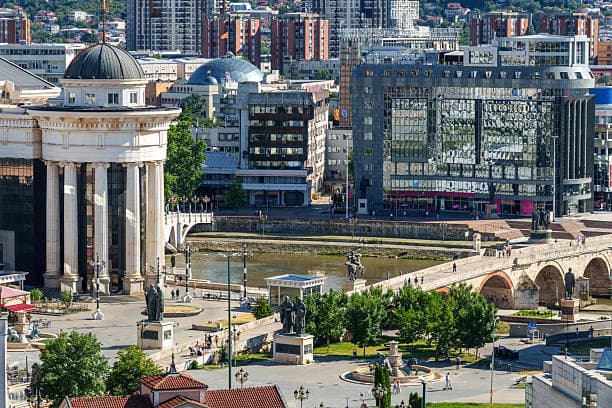
Skopje divides into several neighborhoods with radically different atmospheres. The south bank concentrates the Skopje 2014 project: fountains, triumphal arches and colossal statues of Alexander the Great or Mother Teresa, born here in 1910. The north bank shelters the Čaršija, the grand Ottoman bazaar, and Kale Fortress which dominates the city from a rocky promontory.
History and context
Inhabited since the Neolithic, Skopje was capital of the medieval Serbian kingdom, then conquered by the Ottomans in 1392. It remained under Ottoman rule until 1912. Integrated into Yugoslavia, it was almost entirely razed by the earthquake of July 26, 1963 (magnitude 6.1), which killed over a thousand. Reconstruction, supported by massive international aid, gave birth to the modernist city of the 1960s-1970s. The Skopje 2014 project, launched under the Gruevski government, subsequently covered the center with a controversial neoclassical layer.
Highlights of the visit
The Čaršija (Ottoman old bazaar)
The Čaršija is one of the largest still-active Ottoman bazaars in the Balkans. Its cobbled streets house goldsmiths, spice merchants, traditional cafés and mosques. The atmosphere is authentic, far from the theater of the center.
Kale Fortress
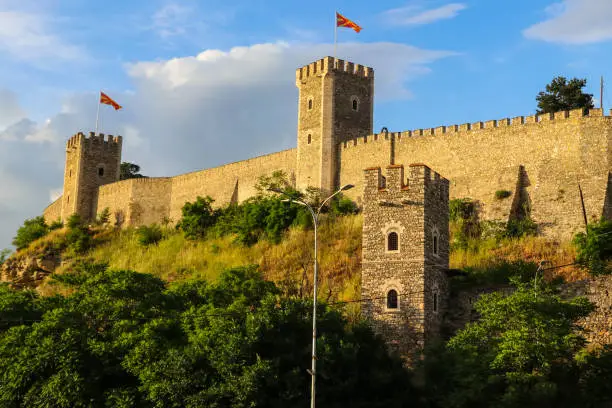
Perched on a promontory above the Vardar, Kale Fortress offers a panorama over the entire city. The current ramparts date mainly from the Byzantine and Ottoman era. Access is free and the climb takes about fifteen minutes on foot from the bazaar.
The Stone Bridge (Kameni Most)
The Stone Bridge has connected the two banks of the Vardar since the 15th century. Flanked by modern statues, it remains Skopje's most recognizable architectural symbol and the passage point between the city's two worlds.
Mustafa Pacha Mosque
Built in 1492, the Mustafa Pacha Mosque is Skopje's best-preserved Ottoman edifice. Its interior garden and elegant proportions make it a place of calm in the heart of the bazaar.
The Mother Teresa Memorial
Erected at the presumed birthplace of Anjezë Gonxhe Bojaxhiu — known as Mother Teresa — this memorial traces the life of the Albanian-speaking nun born in Skopje in 1910. Free admission.
Etiquette and visiting rules
- In active mosques in the Čaršija, cover shoulders and knees; women must cover their heads.
- Remove your shoes before entering the prayer space.
- Avoid visits during Friday prayer times.
- In Orthodox churches, the same dress code applies; photography is sometimes forbidden inside.
Photography tips
Golden morning light is ideal on Kale Fortress and the Čaršija rooftops. The Stone Bridge photographs well from the landscaped banks of the Vardar, in late afternoon facing west. At night, the statues and fountains of the Skopje 2014 project are illuminated — a kitschy but photographically striking spectacle. Avoid flash in places of worship.
Location and access
Skopje occupies the Skopje plain, surrounded by mountains (Vodno to the southwest, Skopska Crna Gora to the north). The historic center is compact and can be explored on foot. Mount Vodno, accessible by cable car from the Sredno Vodno district, towers over the city at approximately 1,066 meters elevation. Local agencies offer English-speaking guided tours on request.
Nearby
- Mount Vodno — Millennium Cross visible from across the city, accessible by cable car; hiking and panoramic views.
- Matka Canyon — Spectacular gorges about thirty kilometers to the west, with lake, caves and Orthodox monasteries.
- Nerezi Monastery — 12th-century Byzantine frescoes considered among the most important in the Balkans, on the slopes of Vodno.
- Kumanovo — The country's second city, about forty kilometers to the north, with its lively market and old quarters.
Frequently asked questions
Spring (April-May) and autumn (September-October) offer pleasant temperatures and fewer tourists. Summer can be very hot, with temperatures regularly exceeding 35°C (95°F).
Two days suffice for the center, the Čaršija and the fortress. Add a third day if you wish to combine with Matka Canyon or Mount Vodno.
Yes: shoulders and knees covered for everyone, head covered for women, shoes removed at the entrance to the prayer space.
Yes. Ohrid is about 170 kilometers to the southwest. Regular buses connect the two cities; the journey takes approximately three hours.
In mosques, photography is generally tolerated outside prayer times, without flash. In Orthodox churches, rules vary by location; always ask permission on site.
Urban buses serve the Saraj district, departure point for Matka. Taxis and organized tours from central Skopje are also available.
Want to discover this destination?
Our local advisors design your tailor-made trip.