Pelagonia and Bitola
The southern plain between Mount Baba and Pelister, where Bitola preserves its consular façades, Heraclea its Early Christian mosaics and the national park its two glacial lakes.
Pelagonia occupies the largest plain in Macedonia, an agricultural basin stretching some sixty kilometers, nestled between Mount Baba to the west and ridges running toward Prilep to the east. It is a land of wheat, tobacco and sunflowers, where stone villages alternate with market gardens. The Crna Reka river crosses it before curving toward the Vardar. The average elevation of 600 meters moderates summers, but winters are harsh: Bitola regularly records lows of -10°C in January.
Bitola, the country's second city with 75,000 inhabitants, bears traces of its late Ottoman past. In the nineteenth century, twelve European powers maintained consulates here to monitor the Balkans, earning it the nickname city of consuls. Širok Sokak, a long pedestrian street, still lines neoclassical façades from the era, former consular residences converted into cafés, and the national theater hosting an annual season. The Yeni Mosque, the Saat Kula clock tower from the sixteenth century and the Bezisten, an Ottoman covered market, structure the historic center.
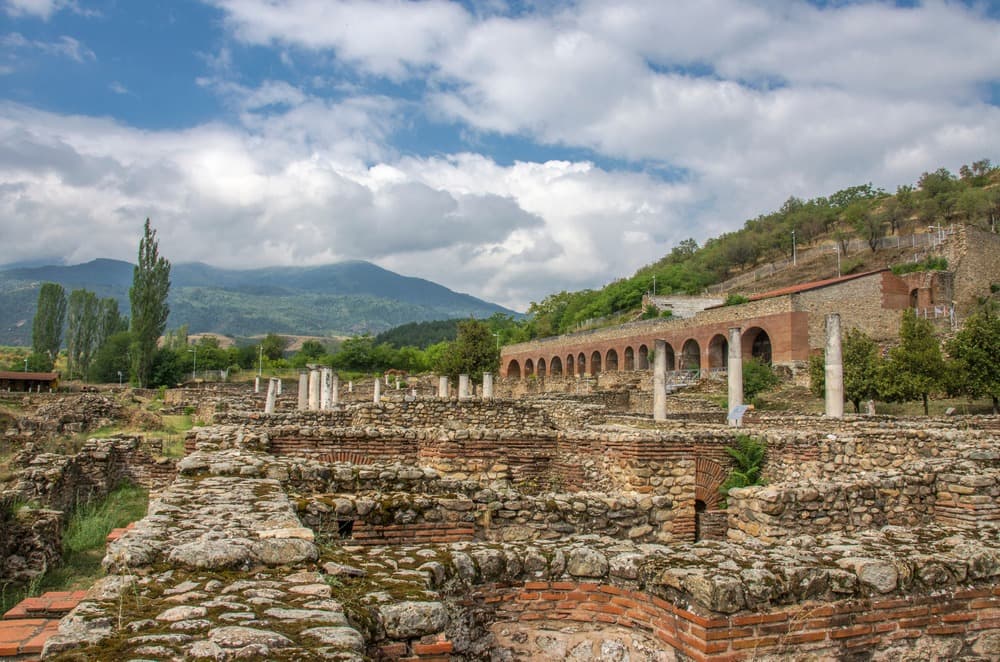
Two kilometers south, the site of Heraclea Lyncestis was founded by Philip II of Macedon in the fourth century BCE. Excavations have revealed a Roman theater, an Early Christian basilica and above all the floor mosaics from the fifth century, where birds, cypresses and pomegranates compose a still-legible Christian paradise. The site remains modest in surface area but possesses rare iconographic density for the region.
Pelister National Park, established in 1948, covers 17,150 hectares of Macedonian pine forests, an endemic species with five needles found only in a few Balkan massifs. The Pelister summit rises to 2,601 meters and provides access to two glacial lakes called the Eyes of the Mountain (Golemo Ezero and Malo Ezero), perched above 2,200 meters. The hike from Nižepole takes about six hours round trip to the Grand Lake, with sustained elevation gain but no technical difficulty. The village of Brajčino, on the southwestern slope overlooking Lake Prespa, serves as an alternative starting point and hosts several stone guesthouses.
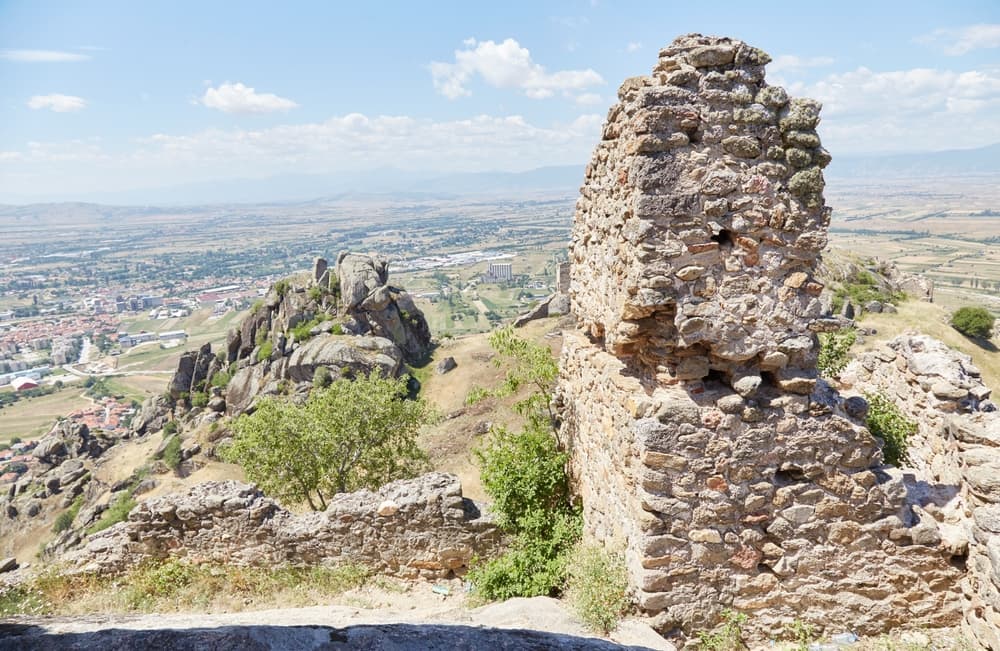
Further east, Prilep is a tobacco town, dominated by the rocks of Markovi Kuli where ruins of King Marko's fortress remain, a legendary figure in South Slavic folklore. About ten kilometers away, Treskavec monastery stands on a promontory at 1,280 meters, accessible by a steep path of about an hour's walk from the village of Dabnica. The Church of the Assumption preserves frescoes from the fourteenth century. The site, still inhabited by a few monks, offers a vertical reading of the Pelagonian landscape.
Local gastronomy makes the most of the plain: ajvar of roasted red peppers in September, Pelister sheep cheeses, Prilep wine from vranec and stanušina grape varieties. Bitola's kafanas still serve tavče gravče, a dish of white beans cooked in earthenware, and sarma of vine leaves. The Manaki Brothers documentary film festival in September enlivens the city for a week, testifying to the region's pioneering cinema history, with the Manaki brothers filming the first images of the Balkans in 1905.
To discover
Širok Sokak and Bitola's center. Evening stroll along the pedestrian avenue, between nineteenth-century consular façades and kafana terraces, to the Saat Kula and the Yeni Mosque.
Mosaics of Heraclea Lyncestis. The floors of the fifth-century Early Christian basilica, peacocks and deer on a vegetative backdrop, two kilometers south of Bitola.
Glacial lakes of Pelister. Six hours round trip hiking from Nižepole to reach Golemo Ezero at 2,218 meters, through endemic pine forests.
Treskavec monastery. About an hour's steep climb from Dabnica to the rocky promontory at 1,280 meters, fourteenth-century frescoes in the Church of the Assumption.
Manaki Brothers Festival. Documentary cinema week in Bitola in September, honoring the cameramen who filmed the Balkans as early as 1905.
When to visit
The best period extends from mid-May through late September. Temperatures in Bitola range between 18 and 28°C during the day, with cool evenings once the sun sets behind Pelister. July and August frequently exceed 32°C in the plain, but the altitude of the national park, starting from 1,400 meters, maintains comfortable conditions for hiking. The glacial lakes are accessible without snow only between June and October. September and early October are our favorite months: red pepper and tobacco harvests, golden light over the plain, light crowds.
Winter is harsh. From December to March, Bitola regularly drops below freezing, and Pelister receives enough snow to operate the small ski station above Nižepole. November and April are rainy transition months, with low skies often obscuring mountain views. We discourage these two months if hiking or Heraclea are on your itinerary.
Practical advice
Allow three full days for the region: one day for Bitola and Heraclea, one day hiking at Pelister, one day for Prilep and Treskavec. The Skopje-Bitola distance is covered in two and a half hours via highway A3 then road 3. Bitola has a small, lightly served airport; in practice, arrival is via Skopje or Ohrid, the latter just 1h45 away by road over the Gjavato pass.
Pelagonia combines naturally with Lake Ohrid to the west (classic loop of 8 to 10 days) or with the Vardar Valley and Tikveš to the east if you wish to add a wine stop. For a comprehensive discovery of the country, we suggest a route through Skopje, Mavrovo, Ohrid, Pelagonia, Tikveš over 12 to 14 days. Hotel comfort is adequate in Bitola (boutique hotels downtown) and more rustic in Pelister villages, where we work with family-run guesthouses. The region suits contemplative travelers, enthusiasts of Ottoman and ancient history, and independent hikers of moderate ability.