Skopje and the North
The Macedonian capital between the Vardar and Mount Vodno, its lively Ottoman bazaar, Matka Canyon 30 minutes away and the prehistoric observatory of Kokino to the north.
Skopje sits in a basin crossed by the Vardar, the river that descends from the Šar massif to meet the Aegean Sea 300 kilometres further south. The city rebuilt itself after the July 1963 earthquake that destroyed 80% of its structures: this is why the centre blends Kenzo-like concrete towers from the 1970s, neoclassical facades laid down during the Skopje 2014 programme, and the other side of the river, Ottoman in character, organised around the Stara Čaršija. This old bazaar remains the largest in the Balkans after Istanbul's. We often begin our circuits here: blacksmiths on Kovački Sokak, silver filigree workshops inherited from Sephardic Jewish families, kafanas where locals drink plum rakija at the bar with regulars.
Above the bazaar, Kale fortress has dominated the confluence since the 6th century. Higher still, Mount Vodno rises to 1066 metres and bears the 66-metre Millennium Cross, visible across the entire valley. A cable car climbs in eight minutes, or you can take the trail that passes through the Saint Panteleimon monastery of Nerezi, founded in 1164, whose Byzantine frescoes prefigure Italian Renaissance painting by two centuries. This is one of the sites our team systematically includes, as few visitors climb up and the cool air is welcome in July-August when Skopje reaches 32°C.
The capital concentrates a third of the country's population, roughly 600,000 inhabitants, and reflects the Macedonian mosaic: Slavic Macedonians, a significant Albanian community around Čair, Roma in Šuto Orizari (the world's largest Roma municipality), Turks, Serbs, Vlachs. This diversity reads in the 15th-century Mustafa Pacha and Sultan Murat mosques, the medieval church Sveti Spas with its walnut iconostasis carved in 1824, or the more recent Saint Clement of Ohrid Cathedral. At table, you alternate tavče gravče (beans baked in an earthenware dish), kebapi grilled over charcoal, and syrup pastries inherited from the Ottoman era.
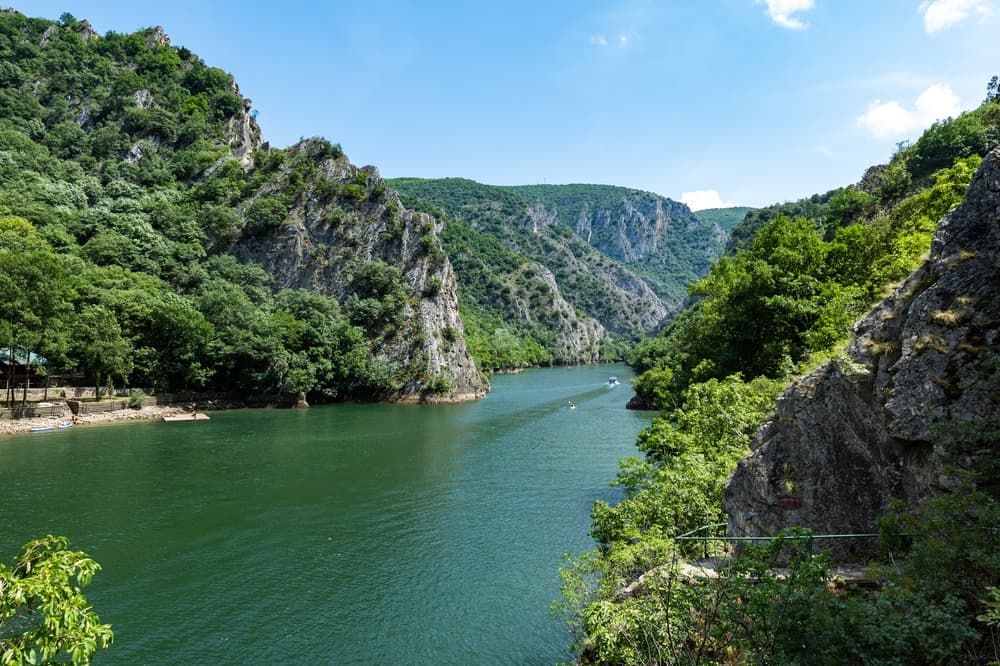
Leaving Skopje takes thirty minutes. To the west, Matka Canyon narrows the Treska river between limestone cliffs of 250 metres. You take a boat here towards the Vrelo cave, whose underwater depth, measured beyond 240 metres, makes it one of the deepest in the world. Saint Andrew's monastery, founded in 1389, holds frescoes contemporary with those of Nerezi. Hikers walk to Saint Nicholas Šiševski monastery or venture onto Mount Karadžica. We often organise a full day at Matka with lunch at the dam restaurant, fresh trout of the day.
Northward, towards the Serbian and Kosovar borders, the landscape shifts. The Kumanovo plain, the country's second city, opens onto schistose hills. It is here, on a plateau at 1013 metres altitude, that the Kokino megalithic observatory stands, dated to 1800 BCE. Four stone markers align the solstices and equinoxes; NASA classified it in 2005 among the world's most ancient archaeo-astronomical sites. The region also counts the Matejče monastery on the slopes of Mount Skopska Crna Gora, and the Kumanovska Banja thermal springs. Further east, towards Kratovo, a village built within the crater of an ancient volcano preserves Ottoman bridges and stone defensive towers.
Skopje's basin climate is markedly continental: 15 to 18°C in April with occasional showers, 28 to 32°C in July and August, sometimes 38°C at peak, mild autumns through mid-November, cold winters with snow almost guaranteed in January and temperatures dropping to -10°C. Atmospheric pollution in December and January, due to wood heating and thermal inversion in the basin, is a real point: we mention this to sensitive travellers.
To discover
Stara Čaršija at early morning. The old Ottoman bazaar before the shops open, when blacksmiths relight their fires and the first Turkish cafés set out on the low tables of the Kapan An caravanserai.
Matka Canyon by boat. Forty minutes navigating the Treska towards the Vrelo cave, among the deepest underwater in the world, followed by a walk to Saint Andrew's monastery and its frescoes from 1389.
Byzantine frescoes of Nerezi. The Saint Panteleimon monastery, on the slopes of Vodno, preserves a cycle painted in 1164 whose Lamentation of Christ is studied as a precursor to emotive Italian painting.
Kokino megalithic observatory. On a volcanic plateau at 1013 metres north of Kumanovo, four thrones carved into the rock served to observe sunrise at solstices 3800 years ago.
Kratovo and its stone towers. A village lodged in an ancient volcanic crater, crossed by high-backed Ottoman bridges and bristling with medieval defensive towers, two hours' drive from Skopje.
When to go
The best window for Skopje and the North spans late April through mid-June, then September through mid-October. In spring, temperatures swing between 15 and 22°C, orchards flower around Kumanovo and the trails of Vodno and Matka are practicable without constraint. Autumn offers clear light, days still at 20-25°C in September, and is harvest market season (peppers, Tikveš grapes if you combine with the Vardar valley).
July and August are hot in Skopje's basin, 28 to 32°C with peaks at 38°C, and the city partially empties weekends. We then redirect days towards Matka (5°C cooler thanks to the canyon) or to higher ground towards Kokino. In winter, from mid-December to February, snow and pollution haze alternate in the basin; it suits a short cultural city break but not regional exploration. January regularly dips below -5°C at night.
Practical advice
Allow two to three full days for Skopje and its immediate surroundings: one day for the old town, the fortress, Vodno and Nerezi, one day for Matka, and a third for the northern loop via Kumanovo, Kokino and possibly Kratovo. Skopje's international airport, 25 kilometres east of the city, is the logical entry point for most of our circuits. Roads are good northward and westward; we work in a vehicle with driver, which allows linking Kokino and a lunch with locals without complicated logistics.
Connectivity from Skopje is broad. The classic route descends towards Lake Ohrid in three hours via the Mavrovo National Park crossing, allowing for a trekking stage in the Šar Planina. Southward, the Vardar valley and Tikveš wine region are reached in two hours, before Bitola and Pelagonia. Skopje suits travellers curious about history and urbanism, families (Matka and the Vodno cable car work well with children), and contemplatives interested in Byzantine frescoes. Hotel comfort in town is good, equivalent to a European capital; outside, we work with a few selected guesthouses in Kratovo and near Matka.