Arabati Baba Teqe
Arabati Baba Teqe
Founded in 1538 in Tetovo by Sersem Ali Baba, Arabati Baba Teqe is one of the largest Bektashi Sufi complexes in the Balkans, nestled against the Šar mountains.
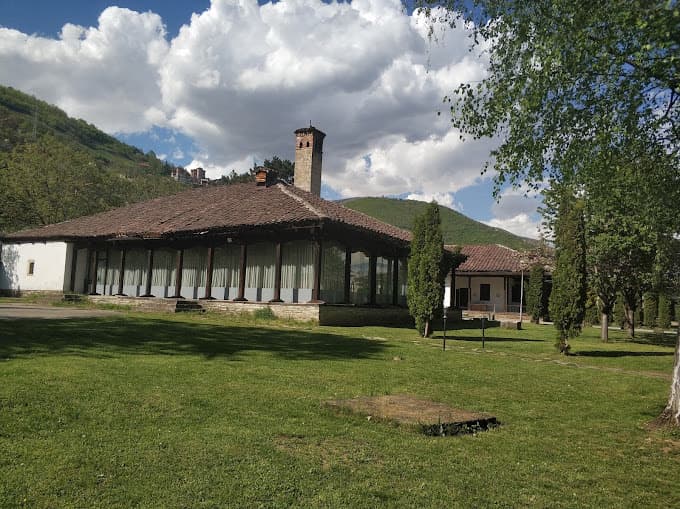
Arabati Baba Teqe (also known as Harabati Baba Teke) is a Sufi monastic complex located in Tetovo, in northwestern North Macedonia. Founded in 1538 around the mausoleum of Sersem Ali Baba, a former vizier of Sultan Suleiman the Magnificent, this Bektashi tekke ranks among the largest and best-preserved Sufi compounds in the Balkans. Its stone walls, wooden pavilions, and garden set against the Šar mountains make it a singular site, where Ottoman civil architecture and Bektashi spirituality converge.
Why visit Arabati Baba Teqe
The site is far more than a simple mosque or isolated mausoleum: it is a complex spanning nearly 200 metres in length and over 100 metres in width, organised around guest houses, a library, a prayer hall, marble fountains and four towers. Such scale is rare in Europe for a Sufi tekke. A visit here also illuminates the Bektashi branch of Islam, a syncretic current drawing from Shia and Alevi influences, distinct from the Sunni orthodoxy dominant in the region. The story remains living history too: the tekke stood at the heart of communal tensions in the early 2000s, traces of which remain visible today.
History
An Ottoman foundation of the sixteenth century
Sersem Ali Baba, a former vizier of Sultan Suleiman the Magnificent, was exiled to Kalkandelen—present-day Tetovo—after falling from grace at the Ottoman court. There, in 1538, he founded his monastery. Initial construction continued until 1548, giving rise to a Bektashi spiritual and educational centre that would radiate influence across the entire region. Upon his death, his disciple Harabati Baba carried on his work and lent the site its alternative name.
The expansion of 1799
A waqf (pious endowment) granted by Recep (Rexhep) Pasha in 1799 enabled the complex to expand and its current boundaries to be fixed. New buildings were added, woodcraft flourished, and the tekke became an architectural and literary reference point for the Bektashi order throughout the Balkans.
Etymology: Harabati Baba
The word "Harabati" derives from the Persian kharaab, meaning "ruin." In Sufi practice, this ruin signifies the destruction of the ego, a necessary step towards union with the divine. "Baba" is the title given to spiritual guides in the Bektashi tradition. The site's name thus encapsulates its entire spiritual purpose.
From the twentieth century to recent conflicts
The end of Ottoman rule in Macedonia in 1912 marked an initial decline. The tekke experienced a brief revival between 1941 and 1945, before being nationalised under Yugoslavia and repurposed as a hotel and museum. The Bektashi community sought recognition as a distinct religious community as early as 1993; the request was denied. In 2002, the Islamic Community of Macedonia (ICM, Sunni), attempted to seize the site to convert it into a mosque. In March 2008, new buildings were occupied by members of the ICM, with gunfire reported within the compound. Today, one building has been converted into a Sunni mosque, while the guest houses surrounding the Bektashi cemetery remain preserved by the original community.
What to see on site
The compound and buildings
The complex forms a rectangle enclosed by stone walls: 5 metres high on the east side, 3 metres on the north and west. Inside, successive structures include:
- The selamllek, the principal guest house for pilgrims
- The summer terrace, opening onto the mountains
- The main residence and winter quarters
- The house of Fateema (Hareem), one of the most finely crafted rooms
- The library, undergoing renovation, which once housed religious and mystical texts
- The kitchen and prayer hall
- The four corner towers; local legend holds that one once sheltered Roxalana, a noble Albanian woman who died of tuberculosis—an oral tale, unverified by documentation
Fountains, sculptures and cemetery
Several marble fountains dot the site, including a large one sheltered beneath a wooden pavilion. Wooden sculptures and Arabic inscriptions testify to Ottoman craftsmanship. To the northwest, the Bektashi cemetery preserves the graves of order figures, their epitaphs in Arabic script blending verses and poetry.
The garden
The inner courtyard contains a garden planted with flowers, roses and fruit trees, where a few animals roam. Set against the Šar mountains, it once served the daily labours of dervishes and charitable works open to all, regardless of faith.
Practical advice
Parts of the complex remain in poor condition, particularly the reception guest house. Allow 1 to 1.5 hours to tour the accessible buildings and garden. Clothing covering shoulders and knees is recommended, and it is customary to remove shoes when entering the prayer hall. Conversations with dervishes present on site often yield deeper insights into the Bektashi way. Donations towards renovation work are welcome.
When to visit
Tetovo enjoys a continental climate shaped by its proximity to the Šar massif. From May through October, conditions are most favourable: mild to warm temperatures, gardens in full bloom, generally clear skies. Summer (July–August) can be hot by day but remains cool at altitude. Winter is severe, with frequent snow; some buildings may be less accessible. Spring is the most pleasant season to enjoy the garden and surrounding mountains.
How to get there
Tetovo lies approximately 45 kilometres west of Skopje, the capital. By car, expect less than an hour via the A2 motorway. Regular buses connect Skopje's main bus station to Tetovo in 1 to 1.5 hours. From central Tetovo, the tekke is situated to the west of the city, near the Pena river and the foothills of Šar; it can be reached by taxi or on foot (approximately 30 minutes from the historic centre).
Nearby attractions
Tetovo is also home to the Painted Mosque (Šarena Džamija), celebrated for its vibrant exterior frescoes, just minutes from the tekke. The Šar Planina massif, on the border with Kosovo, offers mountain hiking. Further afield in North Macedonia, several sites complement a cultural and natural itinerary:
- The Saint Jovan Bigorski monastery, an Orthodox gem adorned with carved woodwork
- The Matka canyon, near Skopje
- The Galitchitsa National Park, between Lakes Ohrid and Prespa
- The Bay of Bones, a reconstruction of a prehistoric lakeside village on Lake Ohrid
Frequently asked questions
Frequently asked questions
Learn more
Arabati Baba Teqe sits naturally within a cultural circuit across North Macedonia, between Ottoman heritage, Orthodox monasteries and mountain landscapes. To plan a complete itinerary, consult our Macedonia travel guide.
Interested in this visit?
We can include it in your personalised itinerary.