Saint Jovan Bigorski Monastery (Saint
Saint Jovan Bigorski Monastery (Saint
Orthodox monastery in Mavrovo Park, famous for its sculpted iconostasis and three-handed icon of Saint John the Baptist, between Debar and Gostivar.
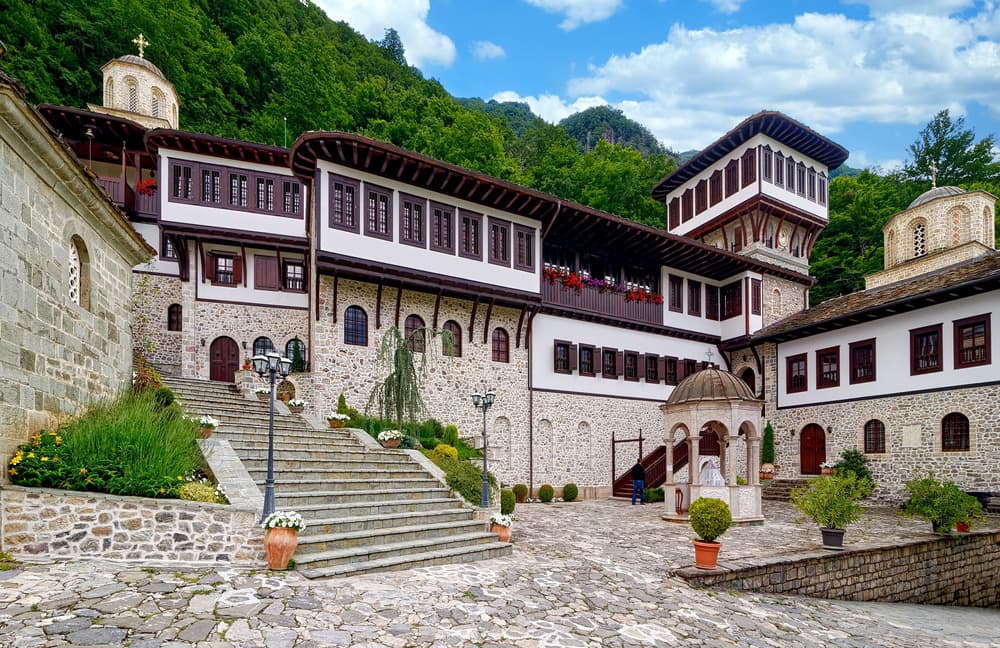
Saint Jovan Bigorski Monastery is a Macedonian Orthodox monastery dedicated to Saint John the Baptist, situated on the north-western slopes of Mount Bistra, within Mavrovo National Park. Overlooking the Radika River valley, between Debar and Gostivar, it houses one of the Balkans' most remarkable sculpted wooden iconostases and preserves important Christian relics.
Why visit Saint Jovan Bigorski
Three elements distinguish this monastery from other religious sites in North Macedonia. First, its sculpted iconostasis carved between 1829 and 1835, considered a pinnacle of Balkan religious art. Second, the three-handed icon of Saint John the Baptist, venerated for centuries for the blessings of fertility attributed to it. Finally, its mountain setting: the complex rises upon limestone tufa rocks, facing the wooded slopes of Mavrovo, making it both a spiritual journey and a scenic pause.
History of the monastery
Tradition traces the monastery's founding to 1020, attributed to John of Debar, an archbishop connected to the Bulgarian Church of that era. According to monastic legend, the icon of Saint John the Baptist was discovered floating on the Radika River, an event that prompted the sanctuary's construction. The name "Bigorski" derives from the Macedonian word bigor, the limestone tufa used for the earliest structures.
The monastery was devastated in the 16th century under Ottoman rule, then abandoned for several generations. In 1743, the monk Hilarion undertook its reconstruction and added cells for the monastic community. Between 1812 and 1825, Archimandrite Arsenius greatly expanded it and commissioned much of the interior decoration visible today.
The monastery's recent history has been turbulent. In 2009, a major fire damaged the refectory and library, but spared the main church and iconostasis. A large-scale restoration campaign was launched in 2010 and continues to preserve the entire complex.
What to see on site
The sculpted wooden iconostasis
The main church's iconostasis is the site's masterwork. Created between 1829 and 1835 by Petre Filipov-Garkata and his workshop, it unfolds across six horizontal levels combining Biblical scenes, floral and animal motifs, figures of apostles, and representations of major religious feasts. At the centre, a crucifix is framed by icons of Saint John the Baptist and the Virgin, complemented by finely sculpted dragon figures.
The three-handed icon of Saint John the Baptist
The icon depicts Saint John the Baptist with three hands, a particularity associated by local tradition with blessings of fertility. According to the monastic account, it disappeared during the Ottoman sacking of the 16th century, then reappeared intact, which strengthened its veneration. In 1885, it was covered with a silver frame to ensure its preservation.
Relics and fragment of the Holy Cross
According to its own archives, the monastery preserves a forearm attributed to Saint John the Baptist, a fragment of the Holy Cross, and a collection of relics of Saint Stephen, Saint Paraskevi of Rome, Lazarus of Bethany, Saint Tryphon, Saint Respicius, Saint Clement of Ohrid, Saint Nymph, Saint Nicholas, and Saint Barbara.
The architectural ensemble
The complex comprises the main church, an ossuary, the Seymen defensive tower, and monks' cells, all designed as a small fortress set against the mountain. A monastic library preserves ancient manuscripts and liturgical objects, and a more recent guest house accommodates pilgrims and visitors.
Monastic life today
The community lives according to Orthodox services, manual labour, and welcoming visitors. The monks practise agriculture, beekeeping, icon restoration, and religious craftsmanship. Simple lodging is offered to pilgrims wishing to participate in services and spend one or two nights on site. Beyond its religious function, the monastery occasionally organises sacred music concerts and exhibitions related to Orthodox heritage.
Practical information
The site is open to visitors year-round, with free admission (a donation to the community is appreciated). A few visiting rules to observe:
- Modest dress required: shoulders and legs covered for both women and men; a headscarf is appreciated for women in the church.
- Silence and discretion inside buildings, especially during services.
- Photography allowed outside; ask explicit permission inside the church.
- Allow 1 to 1.5 hours on site for your visit, longer if attending a service.
Guides can be requested on site for a detailed presentation of the iconostasis and relic collection.
When to go
The most pleasant period extends from May to October, when mountain roads through Mavrovo Park are fully passable and temperatures allow combining the visit with hiking in the surrounding area. In winter, snowfall can complicate access via Route R1202; the monastery remains open but it is advisable to check road conditions. Orthodox feast days, particularly Saint John the Baptist (July 7 according to the Julian calendar), feature more solemn liturgies and attract many pilgrims.
How to get there
The monastery is located in western North Macedonia, between Debar and Gostivar, accessible via Route R1202 which follows the Radika valley. From Skopje, allow approximately 2.5 hours of driving via Gostivar and Mavrovo. From Ohrid, the route passes through Debar and takes about the same time. There are no direct public transport connections to the monastery; a rental car or an organised excursion from Skopje or Ohrid remain the most practical options.
Nearby
The monastery fits naturally into a loop through western Macedonia:
- Galitchitsa National Park, another major protected massif, to combine with the lake region.
- Lake Ohrid and the Bay of Bones, an archaeological site reconstructed on stilts, approximately 2 hours away.
- Near Tetovo, Arabati Baba Teqe, a Bektashi dervish complex that usefully complements understanding the region's religious landscape.
- Matka Canyon, on the return route to Skopje.
Frequently asked questions
Frequently asked questions
Clothing covering the shoulders and legs is required to enter the church for both men and women. Women will appreciate having a light headscarf to cover their head inside.
Yes, the monastic community offers simple lodging to pilgrims and visitors who respect the religious setting. It is best to contact the monastery in advance, as the number of rooms is limited.
Photography is allowed outside the complex. Inside the church, particularly in front of the iconostasis and three-handed icon, you must ask permission and refrain from taking photos during services.
Allow 1 to 1.5 hours to explore the entire complex and observe the iconostasis. If you attend a service or take time to speak with the monks, plan for a half-day.
Learn more
Saint Jovan Bigorski Monastery fits easily into an itinerary combining Skopje, Mavrovo Park, and the Ohrid region. To build your complete itinerary, consult our trips to North Macedonia.
Interested in this visit?
We can include it in your personalised itinerary.